What Makes a Cigar Band a Luxury Object? 3 Lessons From Fuente Opus X
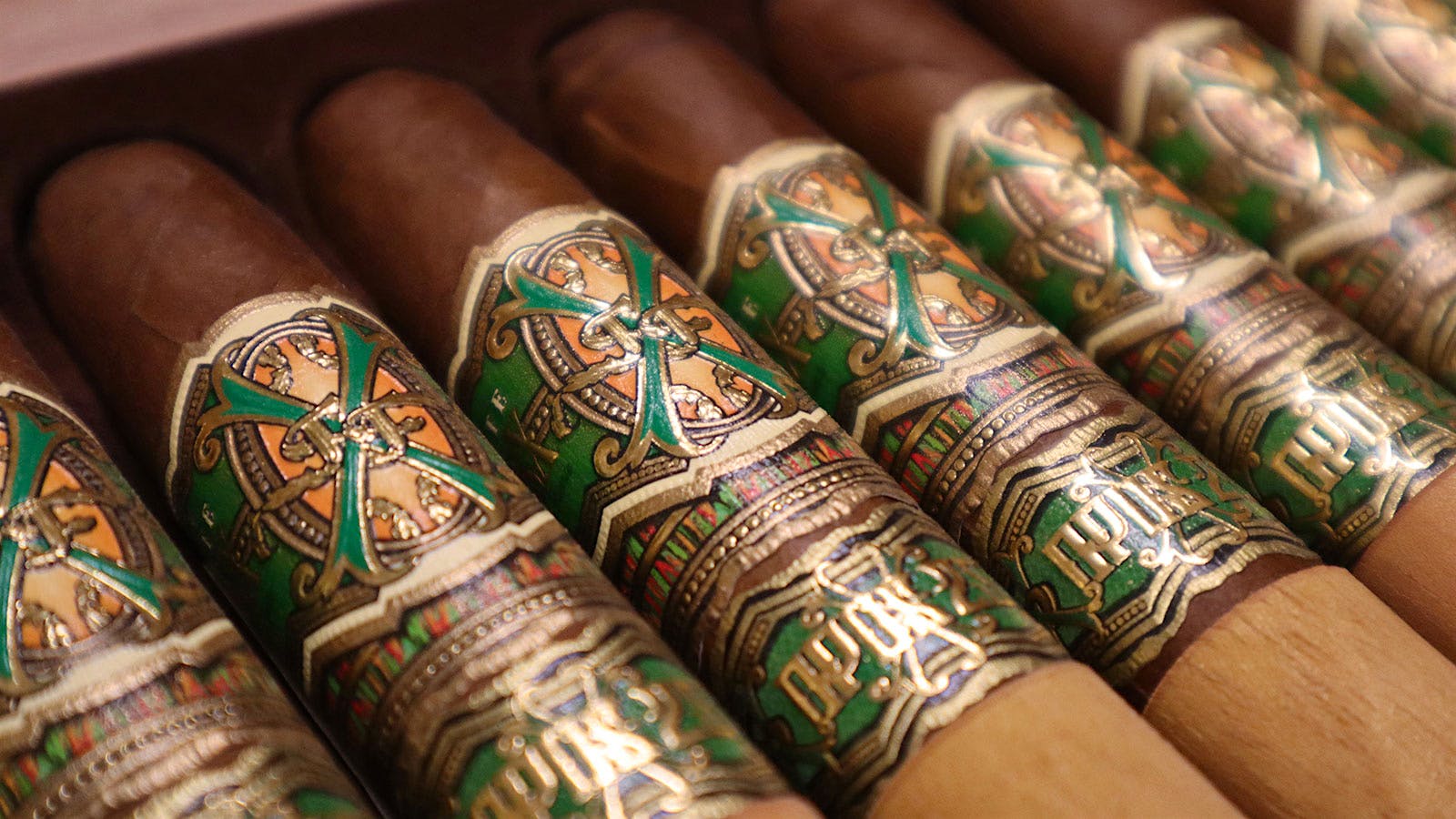
Some cigar bands whisper. A few shout. And then there is Arturo Fuente Opus X El Tributo — a band that doesn’t do either. It performs. Crosses and scrolls. Gilded foil layered over gilded foil. A border that looks closer to heraldry than to packaging. Pick one up out of the box and it does not feel like a strip of paper. It feels like a small, deliberate artifact — the kind of object you put back down carefully because something tells you it matters.
That band is the Fuente Opus X El Tributo. For a quarter century, Opus X bands have been red-orange and unmistakable. The El Tributo release flipped that rule on its head and went green. Same ornament. Same weight. Different color. One anniversary worth marking. The result is one of the most discussed luxury cigar band studies in the modern humidor — and one of the best teaching examples available to anyone designing a band of their own.
Three lessons sit inside that ornament. Each is a principle you can lift and apply to your own premium cigar band. Here is what Opus X El Tributo teaches us about ornament as legacy — and how to design a band that rewards the second look.
Why Cigar Band Ornament Matters More Than You Think
A cigar band is the smallest piece of real estate in your entire brand. It is also the most public. The cellophane goes to the trash, the box stays on a shelf at home, but the band is what a customer holds between two fingers at a closing dinner, a wedding, a porch in late October. It is the piece of your packaging that gets seen, photographed, and described. It is the part a customer carries into their next conversation.
For decades, the dominant idea in custom cigar band design has been reduction. Trim the type. Drop the borders. Strip the band back to a single mark and let restraint do the talking. That principle holds — up to a point. There is another principle, just as old, that does the opposite. It says: when the cigar inside has heritage, the band should look like it carries that heritage on its sleeve. When restraint reads as confidence, ornament reads as proof.
The brands that do this well don’t throw decoration at the band hoping something sticks. They commit to ornament the way an architect commits to a cornice or a carriage maker commits to a coat of arms. Every flourish is deliberate. Every gilded edge is earned. The result is a band that feels less like a label and more like a coat of arms in miniature. The Fuente Opus X El Tributo band is the cleanest modern example of that approach in any humidor.
A Case Study in Heritage: Fuente Opus X El Tributo
The Opus X line was launched by the Fuente family in 1995 as the first premium puro grown entirely from Dominican Cuban-seed tobacco. The cigar itself is a feat of agriculture before it is a feat of blending — the Chateau de la Fuente farm in El Caribe was once dismissed as impossible terroir for premium wrappers, and the family spent years proving the dismissal wrong. The band has carried that story for three decades, and the El Tributo release commemorates it.
The El Tributo band system layers the recognizable Opus X heraldry — the cross, the scrolls, the dense ornamental border, the gilded type — on a deep tributary green instead of the long-standing red-orange. The foot band repeats the ornamental motif in tight succession. Every element is foiled and embossed, with the gilded passages catching light at multiple depths as the cigar rotates. There is no negative space. There is no rest. The band is full of itself, in the best sense of the phrase.
Three lessons live inside that design. Each one is a tool you can pick up and use on your own band.
Lesson 1 — Density Signals Worth
The cleanest version of this principle: when every other premium cigar band in the room is trying to look quieter, looking louder is the loudest signal you can send. Opus X doesn’t hedge. It saturates the band with detail and lets the detail do the work. Crosses and scrolls. Decorative cartouches. A border within a border within a border. The eye has nowhere to land that isn’t ornamented, and that is the point. The brand is announcing, in the visual vocabulary of heraldry, that the cigar inside is the product of generations of craft.
This is the part of ornament that designers untrained in heritage work get wrong. They assume ornate means cluttered, and cluttered means cheap. But ornament only reads cheap when it is undisciplined — when the elements fight each other, when the gilding lands on random passages, when the borders don’t resolve. Disciplined ornament does the opposite. Every flourish earns its place because every flourish is part of a system. The result is density that reads as confidence rather than chaos.
When Ornate Beats Minimal
Ornate is the right play when your brand carries genuine generational heritage, when your category rewards visible craftsmanship rather than visible restraint, or when the band needs to compete for attention inside a crowded humidor. Opus X bands have to hold their own next to Padrón, Davidoff, Cohiba, and a dozen other premium names on the shelf. Ornament gives the band a recognizable silhouette before a customer has read a single word on it.
Ornate is the wrong play when your brand is new and trying to signal modernity, when your wrapper is a clean light shade that ornate gilding will fight, or when your category is moving toward minimalism faster than you are. A band that looks like a coat of arms only works if the cigar inside earns the coat. Plasencia Alma del Fuego, which we covered in the first entry of this series, is the photographic negative of Opus X: one letter, one color, one signal. Both bands work. Both bands commit. Wholehearted ornament and wholehearted restraint are two sides of the same disciplined coin.
Lesson 2 — Color Is Permission to Break Your Own Rules
For twenty-five years, an Opus X band has meant red-orange. The shade is so consistent it functions as a brand asset on its own — a smoker can identify the line from across a lounge without reading a single character on the band. And then, for El Tributo, the family changed the rule and shipped a green band.
This is the move most premium brands are too cautious to make. The brand asset is the rule. Breaking the rule risks the asset. And yet the strongest heritage brands break their own rules precisely because the rule is so well established that the break is meaningful. The green band reads as a tribute exactly because the red-orange band is the default. If Opus X had never had a default, the green release would just be another green band.
The lesson for any premium cigar band designer: a brand rule, once it is genuinely established, becomes a piece of equity you can spend — carefully. You spend it for anniversaries, tributes, limited releases, single-event collaborations. Each break has to be earned by the occasion. Break the rule too often and the rule stops being a rule. Break it once a generation and the break becomes part of the heritage you’re honoring.
Anniversary Colorways for Cigar Brands
If you are designing a luxury cigar band with longevity in mind, build the rule before you plan the break. Pick a primary band color that you can hold for the first three to five years of the brand. Use it on every release. Let your customers learn it. Then, when an anniversary, a milestone, or a tribute release arrives, commission an alternate colorway that keeps every other element of the band identical. Same ornament. Same gilding. Same type. Only the color shifts.
This is what the Fuente Opus X El Tributo band does so cleanly. The ornament didn’t change. The cartouches didn’t change. The crosses, the borders, the gilded foil — all identical to the standard Opus X band. The color carries the entire commemorative weight, which is why it works. Anniversary colorways fail when designers use the occasion to redo the entire band. The customer can’t connect the new band to the old one, and the heritage signal gets lost. The strongest custom cigar band design for an anniversary release is the existing band, repainted.
Lesson 3 — A Band Can Be an Heirloom Marker
Some cigar bands end up in the ashtray with the wrapper. A few end up on the desk for a day or two. And then there are bands that end up in a small lacquered box in a smoker’s study — saved, sometimes for years, alongside the bands of other notable cigars from notable nights. Opus X bands have spent three decades in those boxes. The El Tributo band is being added to them now.
That is the highest function a cigar band can serve. It is no longer packaging. It is no longer signage. It is an artifact — a small, dated record of an evening. The customer keeps the band because the band rewards being kept. It rewards the second look at the moment, the third look the next morning, and the look a year later when it surfaces from the drawer.
Designing Bands That Reward a Second Look
An heirloom-grade band has three load-bearing features. First, dimensional finish — foiled and embossed cigar band construction that gives the band physical relief. A flat-printed band is a record of the cigar. An embossed band is a record of the evening. The fingertips feel the design before the eyes do, and that tactile memory is what makes the band worth saving.
Second, density that rewards inspection. The reason an Opus X band gets kept is that there is always one more element a customer hasn’t fully noticed yet. A scroll inside a border. A motif inside a cartouche. A foiled passage that catches light at a specific angle. Density isn’t clutter when every element is its own small reward. It is the visual equivalent of a watch dial with sub-registers — complexity that earns the viewer’s attention rather than fighting for it.
Third, a sense of ceremony in the materials. Heirloom bands use slightly thicker paper stock, denser foil deposits, and embossing dies cut with finer relief than standard production bands. The cost difference per unit is modest. The difference in feel is exponential. The customer can’t articulate why the band feels different in the hand — they just know it does. That is the entire point.
How to Apply These Lessons to Your Own Cigar Brand
If you are designing a band for a new line, or rethinking the one you have, here is how the Opus X El Tributo lessons translate into a practical brief for your own custom cigar band design.
Decide whether your brand is reductive or ornamental, and commit. The single biggest failure mode in premium cigar band design is bands that are 60 percent reduced and 40 percent ornamented — trying to look clean while also trying to look ornate, and accomplishing neither. Decide which lane your brand lives in based on the cigar’s positioning. Then commit to that lane wholeheartedly.
Build the rule before you plan the exception. If you want the option of doing a tribute or anniversary band someday, you need a baseline band that has been consistent long enough to be worth breaking. Spend the first three to five releases reinforcing one palette, one ornamental system, one type treatment. The strength of an anniversary band depends entirely on the strength of the rule it’s breaking.
Design for the drawer, not just the humidor. Ask yourself whether the band is good enough that a customer would save it. If the answer is no, the band is too thin in its design or too plain in its finish. Add dimensional finish. Add density. Add the small rewards a viewer discovers on the second look. The drawer test is the highest standard a band can be designed to meet, and the brands that meet it are the brands that get talked about a year later.
Foiled and embossed is the floor, not the ceiling. If you are designing in the heirloom register, foiled and embossed construction is not an upgrade — it is the baseline. From there you can go further: multi-level emboss, multi-color foil, sculpted dies, specialty paper stocks, custom edge treatments. Opus X bands use most of these techniques layered on top of each other. The cost is real. The perceived value is exponential.
Frequently Asked Questions About Premium Cigar Band Design
What makes the Fuente Opus X El Tributo band a luxury object?
The Fuente Opus X El Tributo band combines three load-bearing luxury cues: heraldic-density ornament (crosses, scrolls, layered gilded borders), a deliberate anniversary colorway (deep green instead of the long-standing Opus X red-orange), and a foiled and embossed construction that gives the band physical relief. Together, these elements turn the band into an heirloom marker rather than disposable packaging — the kind of band customers save in lacquered boxes alongside the other notable cigars of their lives.
How much does a custom cigar band cost?
Custom cigar band pricing depends on volume, finish, and complexity. Flat-printed bands typically run a few cents per unit at high volume. Foiled and embossed cigar bands cost roughly 30 to 60 percent more per unit, with diminishing per-unit cost as volume increases. Heirloom-grade construction with multi-level emboss, multi-color foil, or specialty paper stocks adds additional cost. Most boutique brands order in batches of 1,000 to 10,000 bands, and the bands that customers describe to their friends a week later are almost always the higher-finish ones.
What is a foiled and embossed cigar band?
A foiled and embossed cigar band uses two finishing techniques together. Foil stamping applies a thin layer of metallic or custom-color foil to specific elements under heat and pressure, creating reflective passages that change as the cigar rotates. Embossing uses a metal die to raise (or recess) design elements off the paper surface, creating physical relief the fingertips can read. On Opus X El Tributo bands, both techniques are layered repeatedly — the gilded ornament is foiled, the borders are embossed, and the cartouches combine both. The result is a band with both visual and tactile depth.
Why did Fuente change the Opus X band color for El Tributo?
The Opus X line has used a red-orange band as its primary brand asset for twenty-five years. The El Tributo release commemorates that quarter-century with a deep green colorway that keeps every other element of the band identical — the ornament, the gilding, the type, the dimensional finish. Changing only the color allows the new release to read clearly as a tribute while preserving the visual heritage of the line. The shift works as a design move precisely because the rule it’s breaking has been established long enough to be worth breaking.
Can a new cigar brand design a band as ornate as Opus X?
Yes, but ornate only works when the ornament is disciplined. The failure mode in ornamental band design is undisciplined density — decorative elements pulled from stock vector libraries, gilding applied to random passages, borders that don’t resolve into a system. A well-designed ornate band is built around a coherent visual vocabulary (heraldry, art deco, baroque, victorian) and executed at a consistent level of finish throughout. Density signals worth only when the density is intentional. Anything else reads as clutter.
Ready to Design a Band Worth a Second Look?
At Cigar Bandz, we craft foiled and embossed cigar bands using the same dimensional finishing techniques you see on Opus X, Padrón, Davidoff, and the other heritage names in the humidor. Whether you are launching a new ornate line, planning a tribute release for an existing brand, or developing a single private-label run that needs to feel like an heirloom from the first puff, the difference between a band a customer throws away and a band a customer saves sits on a quarter-inch of foiled paper.
If you are ready to talk through what your band could look like — the ornament, the colorway, the finish — we offer a free 30-minute consultation. No obligation. No template pitch. Just a conversation about the smallest, most public piece of paper in your packaging, and what you want it to say about the cigar inside.
Book a free consultation with Cigar Bandz
A great cigar band rewards the second look. What will yours reward?



All rights reserved. © 2023 Cigar Bandz. No part of this website may be reproduced, distributed, or transmitted in any form or by any means without the prior written permission of Cigar Bandz. Unauthorized use is strictly prohibited.
+1 321-321-2720
Products & Services
Additional Information