What Makes a Multi-Band Cigar Design Work? 3 Lessons From My Father Le Bijou 1922
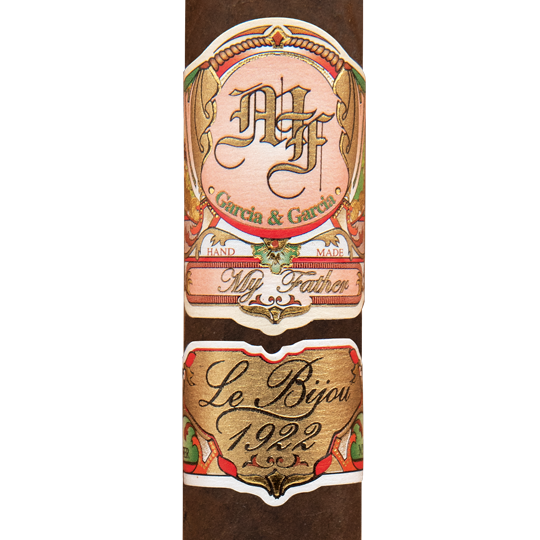
Pick up a My Father Le Bijou 1922 and the first thing you notice is that it isn’t wearing one band. It’s wearing three. A crest at the head. A signature sash just beneath it. An ornate foot band at the other end. Pink, orange, gold filigree, against an oscuro wrapper that on paper should clash with every one of those colors. It doesn’t. It sings.
That cigar is My Father Le Bijou 1922, named for the year Don Pepin Garcia’s father was born — a Garcia-family flagship dressed in Victorian filigree, a soft-pink primary band that no luxury cigar is “supposed” to wear, and a foot band that finishes the sentence the head band started. Three pieces of paper. One generational story. A cigar wearing its own genealogy on the outside of the leaf.
It’s also one of the cleanest case studies in premium cigar band design for any cigar brand thinking about going multi-band. Three deliberate design choices. One unmistakable family signal. Here’s what the My Father Le Bijou 1922 band system teaches us about layered, story-driven cigar band design — and how to lift those principles for your own line.
Why Multi-Band Cigar Design Matters More Than You Think
A cigar band is the smallest, most-photographed piece of real estate in your entire brand. Most brands get one shot at it — one band, one mark, one strip of paper to do the work of a logo, a tagline, a vintage statement, and a country-of-origin call-out all at once. The result is what you see across most humidors: a single band trying to say everything, signaling almost nothing.
Multi-band design is the answer to that problem — but only when it’s used with discipline. When a brand splits its messaging across two or three bands, each band can finally do one job well. A primary band can own the family identity. A sash can own the brand line. A foot band can own the specific blend or release. The cigar gains depth without any single band losing focus.
And yet most custom cigar band design work that goes multi-band falls into the same trap: it duplicates information across bands instead of distributing it. The brand name appears twice. The country of origin appears twice. The crest competes with itself. The reader’s eye ping-pongs between two near-identical marks with no clear hierarchy. The cigar ends up wearing two bands that argue rather than three bands that converse.
The bands that actually move premium cigars are the ones that split the story cleanly. My Father Le Bijou 1922 is the textbook example.
A Case Study in Storytelling: My Father Le Bijou 1922
Released by My Father Cigars in 2007, Le Bijou 1922 is a Nicaraguan puro built around an oscuro habano wrapper grown on the Garcia family’s own farms in Esteli. The name — Le Bijou, French for “the jewel” — and the date — 1922, the year Don Pepin Garcia’s father, Jose “Pepin” Garcia Sr., was born — carry the whole emotional weight of the brand. Inside the leaf, it’s a master blender’s cigar. Outside, it’s a master storyteller’s cigar.
The band system has three components. A primary band carrying the My Father crest in soft pink with gold filigree. A signature sash just below the crest, anchoring the brand line in script type. An ornate, fully-illustrated foot band naming the specific blend — Le Bijou 1922 — in bright orange and gilded scrollwork. Every band is foiled and embossed. Every band sits in its own register on the cigar. Nothing repeats. Nothing fights.
Three lessons sit inside that luxury cigar band system. Each one is a design principle you can apply to a multi-band release of your own.
Lesson 1 — Three Bands, Three Stories
The single most important design move on the Le Bijou 1922 isn’t the color, or the filigree, or the embossing. It’s the decision to split the message into three discrete bands, and to give each band exactly one job.
The primary band names the family — My Father, the Garcia parent brand. The signature sash names the line within the family — the script wordmark that tells you which corner of the Garcia portfolio you’re holding. The foot band names the specific blend and its vintage — Le Bijou 1922, the personal reference inside the personal reference. Read the cigar from head to foot and you’ve read the genealogy: family, line, release.
Most multi-band cigars don’t do this. They put the family name on the primary band and then put the family name again on the secondary band, or they put the country of origin on the foot band and the country of origin again on the head. The bands become redundant decoration. The customer learns nothing new as their eye travels.
The Le Bijou approach treats each band as a layer of the story. The customer who only glances learns the family. The customer who looks twice learns the line. The customer who picks the cigar up, rotates it, and reads the foot band learns the specific blend and the year that gave the cigar its name. Each tier of attention is rewarded. That’s what good multi-band design does.
When a Multi-Band Cigar Makes Sense
A multi-band system is the right play for three kinds of brands. The first: brands with a portfolio big enough that a single band can’t reasonably carry both the parent identity and the line identity. The second: brands releasing a limited or commemorative edition that needs to signal “this is a special version of the line you already know.” The third: brands with a real generational or family story to tell, where layering literally reflects the layered narrative.
It’s the wrong play if you’re a single-line brand without a portfolio yet, if you don’t have a real second piece of information to put on a second band, or if your budget can’t support the unit cost of three foiled and embossed pieces of paper instead of one. When a multi-band design is forced, the customer reads it as overdesigned. When it’s earned, the customer reads it as heritage.
If you’re considering multi-band, ask the design question first: what are the two or three pieces of information that genuinely belong on separate registers? If you can’t name them without overlap, you don’t need three bands. You need one band with better hierarchy.
Lesson 2 — Color Pairings Carry Feeling
The Le Bijou 1922 palette shouldn’t work. An oscuro wrapper — the darkest, most serious-looking leaf in the Nicaraguan playbook — paired with a soft, almost rose-pink primary band, paired with a bright orange foot band, all threaded with gold filigree. The color theory is unorthodox. The result is unmistakable.
Most luxury cigar palettes default to a narrow band of safe choices: black, gold, deep red, cream, navy. The thinking is risk-averse and brand-protective — nobody ever got fired for putting gold on a black band. The problem is that nobody remembers your cigar, either. Luxury that’s afraid to dare a color becomes wallpaper in the humidor.
The Le Bijou palette dares the colors a focus group would have killed. Pink reads as feminine in most consumer contexts — and Le Bijou wears it anyway, with enough filigree and gold weight around it that the band reads regal rather than soft. Orange reads as casual or fast-food in most consumer contexts — and Le Bijou wears it anyway, on the foot band, where the contrast with the oscuro wrapper turns it into a flame motif. The unexpected pairings are exactly what makes the band feel personal rather than corporate, hand-chosen rather than committee-approved.
The lesson isn’t “use pink and orange.” The lesson is that color is one of the cheapest, most underused tools in the premium cigar band design kit. The brands that win don’t default to the safe palette. They pick a palette that means something specific to the line and commit to it across every band in the system.
Designing Cigar Bands With Unexpected Palettes
The trick to making an unexpected palette feel premium rather than novelty is anchoring it with one classic finishing element. On Le Bijou, that anchor is the gold filigree — it threads pink, orange, and oscuro together and tells the eye “this is still a heritage cigar.” Without the gold, the pink-and-orange combo would read like a candy wrapper. With the gold, it reads like a wedding invitation from 1922.
If you’re designing your own off-palette band, pick one stabilizing element and keep it consistent: a gold foil, a deep cream paper stock, a black wordmark, a serif typeface in a single weight. Then build your daring colors around it. The classical anchor gives the customer permission to accept the unusual palette as intentional.
Beware the most common mistake when going off-palette: pulling more than one daring move at once. Daring color plus daring typography plus daring shape plus daring finish equals chaos. One daring move per band, anchored by classical execution everywhere else, is the formula behind most luxury cigar bands that successfully break their category’s defaults.
Lesson 3 — Ornate Victorian Detail Says Heritage
Look closely at any of the three Le Bijou 1922 bands and you’ll see the same visual vocabulary: hand-illustrated floral borders, scroll-work corners, a script Le Bijou 1922 plate set inside an ornate cartouche, dotted backgrounds that mimic Victorian engraving. It’s the design language of pre-war labels, of antique perfume bottles, of jewelry boxes that have been in a family for four generations.
This is deliberate. The cigar is named for 1922 — the year the founder’s father was born — and the band is dressed in the visual vocabulary of that era. The design isn’t copying a Victorian band. It’s borrowing the visual codes that the customer already associates with permanence, craft, and inheritance. Heritage isn’t about being literally old. It’s about choosing the visual language of things that were meant to last.
The Victorian density of the Le Bijou bands also serves a second function: it rewards close inspection. The customer who glances sees pink, gold, and orange. The customer who looks closely sees floral scrolls, a hand-drawn cartouche, a year embedded in filigree. Most cigar bands give up everything they have at first glance. The Le Bijou bands keep revealing themselves the longer you hold the cigar. That’s the second-look effect that premium customers describe as “feeling expensive in the hand.”
Using Period-Specific Detail in Cigar Band Design
Period-specific detail is one of the most reliable shortcuts to perceived heritage in custom cigar band design. The trick is to pick a period that genuinely aligns with the brand’s story and execute it with technical precision rather than vague flourish. Le Bijou 1922 is Victorian because the brand’s story is 1922. A cigar named for a Cuban founder’s journey in 1959 would lean mid-century. A cigar built around a pre-Castro tobacco field might lean Art Nouveau. The era is part of the storytelling.
Where this lesson goes wrong is when brands borrow ornate detail without a reason. A heritage flourish without a heritage story reads as costume. The filigree has to point somewhere — a year, a person, a place, a chapter of the brand’s real history. Otherwise it’s just decoration, and decoration alone has never sold a cigar.
The technical execution matters as much as the historical reference. A Victorian band needs to be foiled and embossed to actually evoke the period — flat-printed Victorian detail looks like a coloring book. The foil catches light the way real metallic engraving caught light a century ago. The emboss raises the filigree the way real letterpress raised it. The era you’re borrowing demands the finishing it was originally produced in.
How to Apply These Lessons to Your Own Cigar Brand
If you’re designing a multi-band system — or thinking about expanding a single-band cigar into a multi-band release — the three Le Bijou principles compress into four practical moves.
Split the story before you split the bands. Don’t go multi-band first and figure out what each band says second. Write the story first: family, line, blend, vintage, founder, region. Pick the three pieces that genuinely belong on three different registers. If you can’t separate them cleanly, you don’t need a multi-band system. You need a better single band.
Give each band exactly one job. The crest names one thing. The sash names one thing. The foot band names one thing. No overlap. No duplication. Each band earns its place by carrying information the others don’t. This is the discipline that separates Le Bijou from the “cigars with three bands that all say the same thing” category.
Pick a palette that means something. Don’t default to black-and-gold because it’s safe. Pick the colors that align with the line’s story and commit to them across every band in the system. If your story has a year, a place, a personal reference — let the colors point there. Anchor any daring choice with one classical element so the band still reads premium.
Commit to foiled and embossed finishing on every band in the set. A multi-band system fails if one band feels more premium than the others. The customer reads the inconsistency before they read the design. If you’re going multi-band, all three bands need the same paper stock, the same finishing technique, the same level of detail. The set has to feel like a set.
Frequently Asked Questions About Premium Cigar Band Design
What is a multi-band cigar and why are some cigars wearing three bands?
A multi-band cigar wears two or more decorative bands instead of the standard single primary band. The most common configuration is a primary band at the head plus a secondary foot band at the opposite end, but premium releases like My Father Le Bijou 1922 use three: a primary band with the parent brand mark, a signature sash with the line name, and an ornate foot band with the specific blend or vintage. Each band carries one piece of the story so no single band has to do all the work. Done well, multi-band design creates depth and a layered narrative; done poorly, it just duplicates information across registers.
What is a cigar foot band, and when should a brand use one?
A foot band is a secondary decorative band placed at the foot (the lit end) of the cigar, opposite the primary band at the head. It’s typically narrower than the primary band and used to carry one extra piece of information — a vintage year, a limited edition mark, a specific blend name, or a decorative pattern that reinforces the brand. Foot bands are the right choice when the brand has a meaningful second piece of information to communicate (like Le Bijou’s 1922 vintage reference) and the budget to add a foiled and embossed second band to every cigar. They’re the wrong choice when they’re used purely as decoration without carrying real information.
How much does a custom multi-band cigar design cost?
A multi-band design costs roughly 1.5 to 2.5 times what a single-band design costs, depending on how complex each additional band is and whether all bands share the same paper stock and finishing techniques. Each additional band is its own design project, its own print run, and its own foiling and embossing cycle. Most boutique brands considering multi-band start with a primary + foot configuration and expand to a three-band system (primary + sash + foot) for limited editions or anniversary releases where the per-stick economics justify the extra finishing cost.
What is a foiled and embossed cigar band?
A foiled and embossed cigar band uses two finishing techniques together. Foil stamping applies a thin layer of metallic (or custom-color) foil to specific elements under heat and pressure, creating reflective accents that change as the band rotates. Embossing uses a metal die to raise design elements off the paper surface, creating tactile relief. Combined, the two techniques produce the visual depth and physical texture customers associate with luxury cigar bands. On a multi-band cigar like Le Bijou 1922, every band in the set should share the same foiling and embossing treatment so the system reads as cohesive.
How do I tell a family or heritage story through cigar band design?
Heritage storytelling on a cigar band works best when three elements line up: a real personal reference (a year, a name, a place, a generation), a visual vocabulary that matches the era of that reference (Victorian filigree for pre-war, Art Deco geometry for the 1920s and 30s, mid-century modernism for the 1950s, and so on), and a finishing technique that was authentic to the era (foiling and embossing are period-correct for almost any heritage cigar). My Father Le Bijou 1922 lines all three up: a vintage reference (1922), a Victorian visual vocabulary, and foiled-and-embossed execution. Pick a real reference, borrow the visual codes of its era, and finish the bands with techniques that reinforce permanence.
Ready to Design a Band That Tells Your Family Story?
At Cigar Bandz, we craft foiled and embossed cigar bands for boutique cigar brands using the same finishing techniques you see on My Father, Padron, Davidoff, and the other heritage names. Whether you’re launching a new line, expanding a single-band cigar into a multi-band release, or developing an anniversary edition that needs three bands to do the story justice, the difference between “a cigar” and “your cigar” sits on a few quarter-inch strips of foil.
If you’re ready to talk through what your multi-band system could look like — the crest, the sash, the foot band, the palette, the period — we offer a free 30-minute consultation. No obligation, no template pitch. Just a conversation about which pieces of your brand’s story belong on which register.
Book a free consultation with Cigar Bandz
A great cigar band tells you who you came from. What does yours say about you?




All rights reserved. © 2023 Cigar Bandz. No part of this website may be reproduced, distributed, or transmitted in any form or by any means without the prior written permission of Cigar Bandz. Unauthorized use is strictly prohibited.
+1 321-321-2720
Products & Services
Additional Information