What Makes a Trusted Cigar Band? 3 Lessons From Padrón 1964 Anniversary
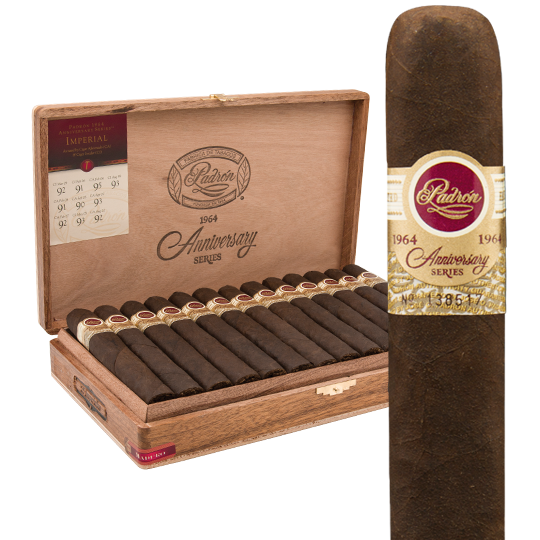
Pick up a Padrón 1964 Anniversary from a humidor shelf and something subtle happens. The first thing you read isn’t a name. It’s a number. A small, four- or five-digit serial printed on a slim second band — Nº 13851, Nº 09227, whichever stick happens to land in your hand. It’s the kind of detail you almost don’t notice. And once you do, you can’t stop noticing it.
That band is the Padrón 1964 Anniversary Series. Cream paper where most premium cigar bands go black-and-gold. A single gold script signature where most brands cram a crest, a flag, a vintage, and three lines of Spanish callouts. And then — quietly, almost shyly — that numbered guarantee band, telling you the factory in Estélí took the time to stamp this exact cigar and stand behind it.
It’s one of the most-studied cigar bands in the modern premium market, and it’s also one of the most-misunderstood. People look at the simplicity and assume the design was easy. The opposite is true. Three deliberate choices sit behind every Padrón 1964 band. Each one is a principle you can lift directly and apply to a custom cigar band design for your own brand. Here’s what the Padrón 1964 Anniversary band teaches us about earning trust on a strip of paper.
Why Cigar Band Verification Matters More Than You Think
A cigar band is a brand’s smallest contract with its customer. Everything else in your packaging — the cellophane, the box, the tissue, the inner wrapper — gets discarded or stored. The band is the only piece a customer sees while the product is being enjoyed. It travels between two fingers at a wedding, a closing dinner, a poker night. It gets photographed. It gets pointed at. It gets remembered.
And here’s the part most brands miss: a customer doesn’t just see a band. They verify it. Subconsciously, in the first half-second of contact, they’re asking is this real, is this worth the price, is this the brand I think it is. If your band can answer those questions before the cap is cut, you’ve already won the impression. The bands that survived the counterfeit wars — the fake Cohibas, the mislabeled Padróns — are the bands that built verification into their design language. A great premium cigar band doesn’t just look authentic. It proves it.
A Case Study in Verification: Padrón 1964 Anniversary
The 1964 Anniversary Series was released by Padrón in 1994 to mark thirty years since José Orlando Padrón rolled his first cigar in Miami. The cigar inside is a Nicaraguan puro — four years aged, hand-rolled in Estélí, available in natural and maduro wrappers. Inside the leaf, it’s a blender’s cigar. Outside, it’s a verifier’s cigar.
The band system has two pieces. A primary band in cream paper with a single gold-foil script — the Padrón family signature and the year “1964” in a contained, almost typeset rhythm. And then a second, narrower guarantee band sitting just below it — same cream paper, same gold, but with one critical addition: a unique serial number printed for that specific cigar. Nº 13851. Different on every stick. Tracked at the factory. Counterfeit-proof.
That’s the whole design. No crests. No flags. No metallic flourishes. No decorative borders. The reduction is the design — and the numbered band is the proof that the reduction was earned. Three lessons sit inside that restraint. Each one is a design principle you can apply to a luxury cigar band for your own brand.
Lesson 1 — A Number Is a Promise
Every Padrón 1964 Anniversary carries a unique serial. That serial isn’t decoration — it’s a contract. The brand is saying, in mechanical, factory-stamped ink: we know this exact cigar exists, we stand behind it, and if a counterfeit ever surfaces, the missing or duplicated number will give it away.
Most cigar bands describe the cigar — country of origin, vintage year, blend, wrapper. Padrón’s numbered band does something different. It commits. It treats every individual cigar as worth tracking. That single design move flips the customer’s subconscious read from “packaging” to “document.” Watchmakers figured this out a century ago: Patek stamps every movement with a serial, Rolex engraves a reference number between the lugs. Padrón is the only major cigar brand that fully adopted that watchmaker logic on the band itself, which is exactly why the 1964 line punches so far above its retail price in perceived value.
When Numbered Bands Make Sense for Your Brand
A serialized band is the right move if your brand sells itself on traceability, limited production, or anti-counterfeit positioning — especially if you run small batches and want each stick to feel like a numbered edition rather than a SKU. It’s the wrong play if your volume is so high the numbering loses meaning, if your positioning is approachability, or if you can’t actually track serials at the factory. A serial that isn’t real is worse than no serial — it’s theater, and savvy customers can smell theater fast.
If a true serialized band is out of reach, the next-best play is a foiled and embossed cigar band with a batch number, lot code, or roller stamp pressed into the foil. The principle is the same: one verifiable, factory-bound detail a counterfeiter can’t easily duplicate. Verification is the signal. The exact mechanism is negotiable.
Lesson 2 — Restraint Sells Craft
Look at the Padrón 1964 band next to almost any other premium cigar band on the same shelf. Most competitors lean into ornament — gold filigree, double-bordered frames, multi-color foil, secondary callouts, country-of-origin flags, vintage-year medallions. Padrón strips it all out. Cream. Gold script. Nothing else.
That kind of restraint is not absence. It’s editing. Every element that could have been on the band got removed because Padrón trusted the cigar to do the heavy lifting. The band’s job is to vouch for the stick, not describe it. This is the same move Hermès makes with the orange box and brown ribbon, Chanel makes with the single-line script, Apple makes with empty white space around the half-bitten fruit. Reduce until what’s left can only be one thing.
The trap most boutique cigar brands fall into is fear of empty space. The band feels “unfinished” without a flourish, so the designer adds a flourish. Then a second mark to balance the first. Then a border to contain the second mark. Within ten revisions, the band looks like a tourist map. Restraint isn’t something you start with — it’s something you earn by removing everything that doesn’t serve the one promise the band is making.
Designing a Restrained Cigar Band
Start by writing one sentence: this band promises [X]. Heritage. Craft. Limited production. Family tradition. Modern luxury. Whatever the one promise is, write it down. Then look at every element on your draft and ask: does this serve that promise, or is it decoration? If it’s decoration, remove it. The band will feel naked. That’s the goal. A great premium cigar band should feel slightly under-designed when it comes off the press, because the cigar itself is the rest of the design.
This is where finish does its heaviest lifting. A restrained band needs to feel substantial when the customer picks it up, otherwise the reduction reads as cheap rather than confident. That’s why every truly minimalist cigar band — Padrón, Davidoff, Plasencia Alma del Fuego, Cohiba Behike — is foiled and embossed. The foil and emboss give the eye and hand the information that ornament would have given. The band is quiet to the eye, but loud to the touch.
Lesson 3 — Wordmark > Emblem (When the Name Carries Weight)
Most cigar bands lead with an emblem — a crest, a lion, a phoenix, a coat of arms, a national flag, a stylized initial. The emblem does the heraldic work, and the brand name sits underneath in smaller type. The Padrón 1964 Anniversary band does the opposite. There is no emblem. There is only the family signature, written in a custom script that has been almost untouched since 1964.
This works for one reason: Padrón has earned it. Forty years of consistent presence in the same script, the same proportions, the same gold-on-cream contrast. Smokers don’t read “Padrón” on the band — they recognize the shape of the wordmark before their brain processes the letters. That kind of recognition takes a decade to build. The Padrón script is a wordmark in the strict design sense: a custom drawing of letterforms, not a typeface set in a brand color. Small choices, hundreds of times reproduced, until the shape itself becomes the brand — the same way the Coca-Cola script outgrew any redesign attempt.
When a Wordmark Beats a Logo
A wordmark is the right play if your brand name is short, memorable, and pronounceable in your primary market. It works especially well if the name is a family name — founders’ names carry inherited gravity in the cigar world (Padrón, Fuente, García, Plasencia). It’s the wrong play if your name is long, generic, or hard to pronounce, or if your brand is too new to have built recognition yet — an emblem can do faster identification work while the wordmark establishes itself underneath.
The mistake to avoid: setting your brand name in a stock typeface and calling that a wordmark. A wordmark is a drawing — a custom letterform construction where spacing, descenders, ligatures, and proportions are decided element by element. Setting your name in Trajan or Bodoni is a logotype, not a wordmark. Padrón’s script, Coca-Cola’s, Disney’s — those are drawings. That’s the bar.
How to Apply These Lessons to Your Own Cigar Brand
Three lessons. One band. Here’s how to translate the Padrón 1964 playbook into a practical brief for a custom cigar band design on your own line.
Build verification into the design. You don’t need a unique serial on every stick (though for a limited release, you absolutely should). What you need is at least one element on the band that proves it came from your factory and not a counterfeiter’s. A lot code in the foil. A batch number under the primary band. A roller’s stamp. A QR code. A watermark visible only under angle light. Pick a mechanism that matches your scale and bake it in from day one.
Reduce until the band feels naked. Most cigar bands fail because they try to communicate four or five things equally. Write your one-sentence promise. Strip every element against it. Remove anything that doesn’t serve the promise. The band should feel almost under-designed when it comes back from your printer — that’s the goal. Restraint is what tells the customer the cigar inside has nothing to hide.
Decide between a wordmark and an emblem — and commit. If your brand is named after a family or a memorable letterform, draw a custom wordmark and treat it as a decade-long investment. Use it on every band, box, ad, and digital touchpoint in the same proportions for ten years. If your name doesn’t carry visually, commission a real emblem with a clear silhouette. Don’t do both. Don’t hedge.
Invest in finish. A restrained band lives or dies on tactile feedback. A flat-printed minimal band reads cheap. A foiled and embossed cigar band with the same minimal design reads expensive. The cost difference is 30 to 60 percent. The perceived-value difference is several multiples. Finish is the load-bearing decision that lets restraint succeed.
Frequently Asked Questions About Premium Cigar Band Design
What makes a Padrón cigar band different from other premium cigar bands?
A Padrón cigar band — especially on the 1964 Anniversary Series and the 1926 Series — is built around verification rather than ornament. Every cigar carries a unique serial number on a secondary guarantee band, and the brand has used the same gold-on-cream script and the same custom Padrón wordmark for almost forty years. The combination of a numbered guarantee, restrained design, and a deeply consistent custom wordmark makes the Padrón 1964 Anniversary band one of the most-imitated and least-successfully-counterfeited bands in the modern premium cigar market.
How much does a numbered or serialized cigar band cost?
A serialized cigar band typically costs 40 to 100 percent more per unit than a standard flat-printed band, depending on the serialization method (printed sequential numbers vs. unique digital codes vs. micro-engraved foil) and the volume. Most boutique brands that want serialization use printed sequential numbering on a secondary guarantee band, which adds roughly 15 to 30 percent over a comparable foiled and embossed cigar band at 1,000 to 10,000 unit runs. The premium pays for both the per-unit numbering process and the factory tracking that makes the numbers meaningful.
What is a foiled and embossed cigar band?
A foiled and embossed cigar band combines two finishing techniques on a single piece of paper. Foil stamping applies a thin layer of metallic or custom-color foil to specific elements under heat and pressure, creating reflective accents that catch the light as the cigar rotates between the smoker’s fingers. Embossing uses a metal die to raise design elements off the paper surface, creating tactile relief that the hand reads independently of the eye. Together, foiling and embossing are the two techniques that move a band from “packaging” to “jewelry” in the customer’s subconscious read. Almost every luxury cigar band on the market — Padrón, Davidoff, Cohiba, Opus X, Plasencia — uses both techniques in combination.
How long does it take to design a custom cigar band with a serial number?
A custom cigar band with serialization typically takes 4 to 8 weeks from first conversation to delivered product. Design and revision rounds account for 1 to 3 weeks. Printing, foiling, embossing, and the additional setup for sequential numbering account for another 3 to 5 weeks, depending on the printer and the complexity of the serialization process. Rush production is sometimes possible at a 25 to 50 percent premium, but the serialization step is the typical bottleneck because each numbered band has to be tracked individually and the print run can’t be ganged the way an unnumbered band can.
Why does cigar band restraint signal quality?
Cigar band restraint signals quality because restraint is hard. Adding ornament is easy — any brand can layer on a crest, a flag, a vintage medallion, a multi-color foil. Removing ornament requires confidence that the cigar inside can carry the brand without help, and customers can sense that confidence in the first half-second of contact. A restrained premium cigar band works the same way a tailored navy suit works: the absence of pattern is the signal. When a brand reduces its band to a single mark and one finish, the band is saying the cigar is the rest of the design. That’s the most expensive thing a band can promise.
Ready to Design a Band That Earns Trust?
At Cigar Bandz, we craft foiled and embossed cigar bands — including numbered guarantee bands, batch-coded secondary bands, and custom-drawn wordmarks — using the same finishing techniques the heritage names rely on. Whether you’re launching a new line, refreshing an existing brand, or developing a limited release that deserves serialization, the difference between “a cigar” and “your cigar” sits on a quarter-inch of foil with a number stamped underneath.
If you’re ready to talk through what your band could promise — the mark, the finish, the verification layer — we offer a free 30-minute consultation. No obligation, no template pitch. Just a conversation about what your brand wants to vouch for with the smallest piece of paper in your packaging.
Book a free consultation with Cigar Bandz
A great cigar band doesn’t shout. It commits. What does yours promise?




All rights reserved. © 2023 Cigar Bandz. No part of this website may be reproduced, distributed, or transmitted in any form or by any means without the prior written permission of Cigar Bandz. Unauthorized use is strictly prohibited.
+1 321-321-2720
Products & Services
Additional Information